I’ve had the misfortune to have to deal with people on PCP (phencyclidine), sometimes referred to as “Angel Dust” a number of times, and on each occasion it wasn’t pretty. Fortunately, I was always part of a team and had assistance; I’m not sure what the outcome would have been otherwise. On one occasion I saw someone who weighed about the same as a photocopy of themselves get the better of two semi-professional boxers who both went on to win commonwealth titles. There may be some reading this a...(Click Here To Read The Article)
There’s a certain “school of thought” that says you should only train how you should/would fight in a real-life situation. I would argue that there are times you should do this – within safety parameters (or what’s the point of “training” you might as well just wait for a real-life attack as that’s what you would be experiencing etc.) – but not all the time. To take the idea to the extreme, I didn’t wear my Judogi when I ran or lifted weights which were all part of my training regime when I was ...(Click Here To Read The Article)
N.B. Just after finishing this article, which contained a generally optimistic message concerning English football hooliganism at the upcoming world cup, I went to check the status of the “Old Firm Clash” between Glasgow Rangers and Glasgow Celtic concerning a Scottish Cup Semi-final fixture (8th March 2026) at Ibrox, to see that it ended with a pitch invasion by both sets of fans, with an “appearance” by the Ranger’s Ultras. Whilst it was a brief confrontation between both sets of fans, and not...(Click Here To Read The Article)
I’ve been a fan of boxing for a long time. There was a time when my interest in MMA (Mixed Martial Arts) eclipsed it, but I quickly came back to the sport. In the 1990’s I held a professional license (UK) for a couple of years (something I gave up because the pay was practically non-existent and the training conflicted with my Judo, which was my real passion/love) and had six professional fights (won four, drew two) – how that all happened is a long and unimportant story e.g., you meet certain p...(Click Here To Read The Article)
Despite having lived in the US for over seventeen years UK prison system is one I have more familiarity with; that doesn’t make me an “expert” on it, and I’m not trying to proclaim myself as one, however it is worth a look, because if the current cutting of expenditure in the US continues, then the US system will be deprived of resources, regardless of whether the prisons are federally, state or privately run etc. From an economic perspective, prisons are a funny business e.g., someone commits a...(Click Here To Read The Article)
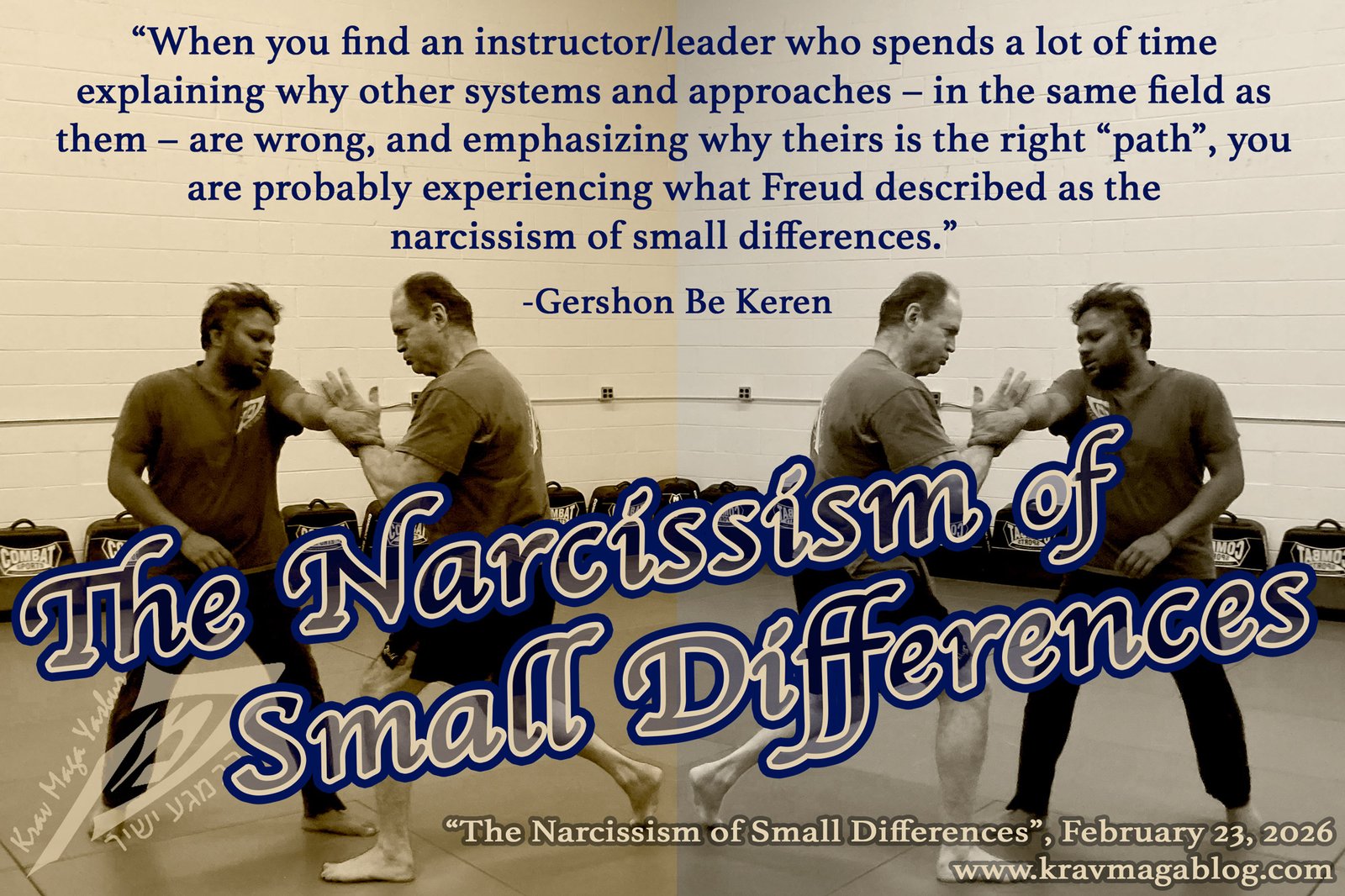
I grew up in the martial arts. I can analyze and rationalize a lot of reasons as to why fighting systems and philosophies intrigued and resonated with me, but at the end of the day it doesn’t matter; this is where I am fifty-four years later, still teaching Krav Maga and self-defense. That’s perhaps the pertinent and relevant point, not just for me but for anyone who is teaching self-defense i.e., we may not be able to fully articulate what drew us and continues to draw us, but we can see that ...(Click Here To Read The Article)